You spend eight hours a day facing this wall. And yet most home office decor guides start with ‘pick a mood’, without ever telling you which of the four walls to cover, or why.
It isn’t a question of mood. It’s a question of position.
In a home office, the role a wall plays in the room determines the pattern. The wall you look at all day doesn’t follow the same rules as the one your webcam films, or the one on your left. Here is how to tell them apart, and what to put on each.
The home office has changed how we look at our walls
With remote working (source: Wikipedia, ‘Remote work’ article), a once secondary room has become a full workspace. Sometimes it’s a proper, closed room. Often it’s a corner of the living room, a niche in a bedroom, a nook under the stairs.
From a closed office to a living room corner: very different set-ups
A closed 10 m² office gives you four separate walls to work with. A desk corner in a 30 m² living room is often limited to the width of a worktop: 120–160 cm as a rule.
The way you choose changes radically depending on the set-up. A made-to-measure home office wall mural suits both cases, to the centimetre.
Why viewing distance changes everything when choosing a pattern
In a 6 to 10 m² office, you can’t step back far. The distance between your face and the wall in front of you is around 1,50 to 2,50 m, sometimes less if the office is deep.
At that distance, a large pattern repeated every 60 cm overwhelms your field of vision. A fine, regular pattern (a scatter of small triangles, concrete texture, marble veining) stays legible without overloading the eye. Keep that rule in mind for the wall facing you.
Wall 1: the one in front of you all day
This is the most important wall. Not because it decorates, but because you look at it for hours without really looking at it. It constantly fills your peripheral vision.
What this wall should (and shouldn’t) do
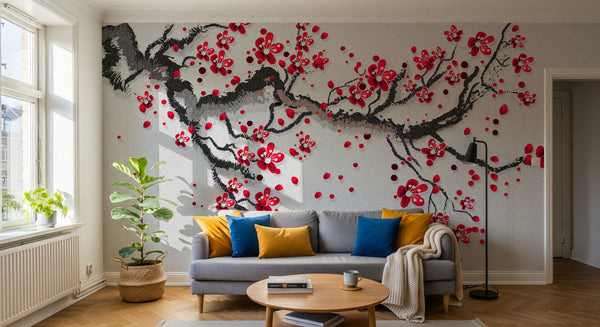
This wall should be calm. Not boring, calm. It shouldn’t draw the eye. A high-contrast pattern (black and white, red and gold, dense florals) catches your eye several times an hour, whether you like it or not.
What you’re after here: low contrast, no detail that needs deciphering, no narrative scene. A texture. A backdrop. Something that exists without imposing itself.
Calm patterns: concrete, white marble, Bauhaus arches, bamboo
Four families of pattern suit this wall:
- Stone and Concrete Texture: raw grey concrete, oxidised copper with a green patina, facets with a drawn relief effect. A material that holds the wall without drawing the eye.
- White Marble: fine veining on a light background. The classic and abstract designs stay discreet even up close.
- Bauhaus Arches in Beige: pastel arches, simple geometric shapes on a neutral background. The Japandi, minimalist look suits this spot perfectly.
- Bamboo: calm vertical lines in sage green, amber or black and white. A verticality that elongates the room without loading the wall.
Light: pale or dark background, and what it means in practice
A pale background reflects natural light towards the desk. In an office without a large window, that is a concrete advantage: the wall contributes to the ambient lighting.
A dark background absorbs light. That isn’t a flaw, but it calls for a dedicated desk lamp to compensate. If your room is already dim, a dark background in front of you makes the space feel even darker.
Also avoid a very high-contrast pattern facing a side window: reflections on the screen become annoying late in the day, when the low sun lights up the wall.
Wall 2: the one your webcam films on video calls
This wall is subject to constraints that decor guides almost always ignore. It isn’t a wall you look at. It’s a wall other people see. And they see it compressed, shrunk, on a 15-inch screen, with an autofocus that is often imperfect.
The technical constraints of the webcam
Three pitfalls to know before choosing.
Moiré. Micro-patterns (fine checks, scatters of tiny dots, tight weaves, hatching) create moiré effects on a webcam. The pattern visually vibrates on screen. The person you’re talking to notices it, even unconsciously. It’s tiring.
Very dark backgrounds. If your main light source is behind you (a window at your back), a dark background absorbs all the light reflected onto your face. You come across as backlit. A light or mid-tone background works better in this set-up.
Overly busy patterns. A dense mural, intertwined flowers, an illustrated map full of detail: on screen, all of it merges into visual noise. Your face gets lost in it.
What works on screen
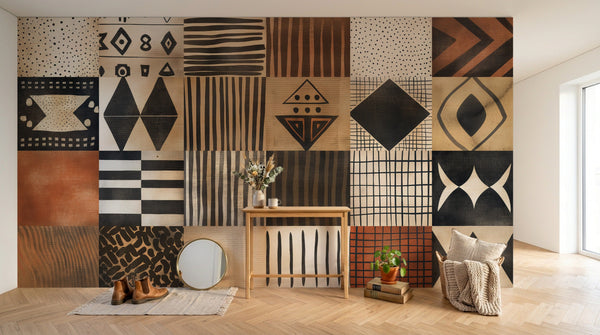
The filmed wall is allowed to be graphic. It’s even the only wall in the office where a bold pattern makes sense. But it has to stay legible on a webcam screen.
Three formats work:
- Large flat areas and bold geometry: 3D trompe-l’œil triangles, navy blue and gold facets. Shapes the webcam renders cleanly. See also the Art & Abstract collection.
- World Map: the watercolour map in orange and blue, the grey map with vintage monuments. Recognisable patterns that give context without loading the image.
- Stone and Concrete Texture or White Brick: a broad, regular material that holds the image without loading it.
What to avoid at all costs as a video call background
- Repeated micro-patterns (a very fine scatter seen from afar)
- Very dark backgrounds if you have no light in front of you
- Busy narrative compositions (dense forest, intertwined floral pattern)
- Shiny gold tones: on matt non-woven, golds are printed in matt shades (ochre, copper, golden bronze), so there is no mirror reflection. That is an advantage for the webcam, but always check the result on a sample.
Wall 3: the one you see out of the corner of your eye
The side wall is the most underrated of the three. You don’t look at it directly. You sense it. And that peripheral perception affects how you relate to your workspace without you being aware of it.
The role of the side wall
This wall doesn’t have to be neutral. It doesn’t have to be graphic. It needs to be restful. A composition the eye skims over without stopping, yet which gives an impression of space or depth.
It is the only wall in the office where a large landscape composition finds its natural place.
Landscapes, forests, mountains: compositions you can look at without being snagged
- Minimalist Mountain Landscape: pastel hills, sunlit hills in flat areas of ochre and teal, silhouetted deer. Simple shapes and distant horizons that open up the perceived space.
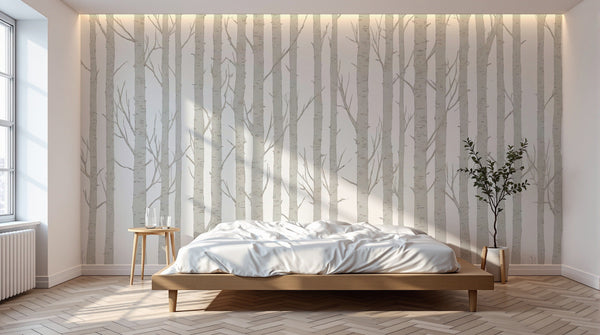
- Pine and Fir Forest: silhouettes of winter trees on a blue-grey background, a misty forest in watercolour. These designs read as well up close as from afar, without tiring your peripheral vision.
- Galaxy and Night Sky: on a side wall, watercolour constellations, the zodiac night sky or the spiral galaxy create depth. Be careful: dark background = dedicated lamp, so as not to darken the whole room.
Special case: marking out a desk corner in a living room or bedroom
Many home offices aren’t rooms. They’re zones. A corner of the living room. An alcove. The space between two windows.
Frame the wall mural to the width of the desk, not the whole wall
Covering the entire living room wall with an office pattern creates visual tension between two spaces that don’t share the same function.
The solution: frame the wall mural exactly to the width of your worktop. If your desk is 140 cm wide, order a wall mural 140 cm wide. No more. You mark out the work zone without touching the rest of the wall.
Made to measure to the centimetre: a clean solution
A standard roll of wallpaper can’t do that. You end up cutting, adjusting, handling pattern matches on non-standard widths. A made-to-measure wall mural is printed to the exact dimensions you enter: from 50 to 500 cm wide, from 50 to 400 cm high.
You enter the dimensions of your wall (or of the area to cover) as they are, without adding anything: 10 cm of trimming allowance are added automatically in width and height. These 10 cm are included in the area you are charged for.
A triangle wall mural in a grey scatter, or Bauhaus Arches in Beige over 140 cm of width: the result is clean, defined, with no overflow.
Tenants: the repositionable self-adhesive finish
Are you a tenant who doesn’t want to stick anything permanently on the walls? The self-adhesive non-woven finish goes up without paste, on a smooth, clean, dry wall. It is repositionable during hanging, which lets you adjust each panel: no paste to prepare, no pasting the wall, no holes. Removal depends on the condition of the wall and the paint: test a small corner first.
At 39,90 €/m², it is the most expensive of the three finishes. It is also the only one of the three that goes up without paste.
Ordering your home office wall mural without mistakes
Taking your measurements: the only rule to remember
Measure your wall in centimetres, width and height. Enter these exact dimensions in the configurator, without adding any margin. The 10 cm of trimming allowance are added automatically.
Novomur prints from 50 to 500 cm wide and from 50 to 400 cm high. Almost every wall in a home office falls within these dimensions.
Smooth, textured or self-adhesive finish: which one for a home office?
Smooth non-woven (29,90 €/m²): the standard choice. Matt finish, suited to most walls in good condition. Hung with paste.
Textured non-woven (34,90 €/m²): a light surface texture that gives the pattern substance. Relevant for concrete, marble and Bauhaus designs that play on the look of the material.
Self-adhesive non-woven (39,90 €/m²): for tenants or for a wall in very good condition (smooth, clean, dry). Goes up without paste, repositionable.
Order a sample before committing
A made-to-measure wall mural cannot be returned or exchanged for a change of mind or an error in the measurements, under Article L221-28 (3) of the French Consumer Code (Code de la consommation); the legal guarantee of conformity still applies. Before confirming, order a 30 × 20 cm sample for 3 € in the finish you have chosen. You will check the colour rendering (golds are matt, not metallic), the grain of the material and the overall look of the pattern.
Delivery takes 7–15 working days, in numbered panels ready to hang. A hanging guide is available on the site.
3 common mistakes with a home office wall mural
Mistake 1: putting a bold graphic pattern in front of you. A contrasting pattern in front of you all day tires your peripheral vision. Keep the graphic look for the filmed wall or the side wall.
Mistake 2: choosing a micro-pattern for the wall filmed on video calls. Fine scatters, hatching and small checks create moiré on a webcam. Prefer large flat areas and bold geometry for the wall behind you.
Mistake 3: covering the whole wall when the office fits in a corner of the living room. Made to measure to the centimetre lets you frame the wall mural exactly to the width of your desk. There is no need to cover all 4 metres of the living room wall to mark out a 140 cm space.
FAQ
Which wall should you cover in a home office? Start with the wall in front of you, the one you look at the longest. Choose a calm, low-contrast pattern: concrete, white marble, Bauhaus arches. The wall filmed on video calls comes next, with a graphic pattern that stays legible on screen. The side wall is for landscapes and large compositions.
Which pattern should you put behind you for video calls? Prefer large flat areas, a world map or bold geometry. Avoid micro-patterns that cause moiré on a webcam, very dark backgrounds if you have no light in front of you, and overly busy compositions where your face gets lost.
What colour should you choose for a small, dark home office? Go for a light background: white marble, light grey concrete, beige arches. A light background reflects natural light and makes up for the lack of a large window. A dark background in a dimly lit office makes the space feel even smaller and calls for a dedicated lamp.
How do you mark out a desk corner in a living room or bedroom? Order the wall mural to the exact dimensions of your work zone, for example 140 cm wide if that is the width of your desk. Made to measure to the centimetre lets you cover only the useful area, without spilling over onto the rest of the wall. The result: a clean visual separation, without touching the rest of the room.
How do you avoid reflections on the screen? Don’t put a very high-contrast pattern facing a side window: the low sun at the end of the day creates reflections on the screen. A matt, light background in front of you, without strong contrast, reduces this. All three finishes are printed on matt non-woven, with no shine.
Which finish should you choose for a rented home office? The self-adhesive non-woven finish (39,90 €/m²) is the one to consider for tenants. It goes up without paste on a smooth, clean, dry wall, and can be repositioned during hanging. Removal depends on the condition of the wall and the paint. Order a 3 € sample first to check adhesion on your type of wall.
Your wall in front of you deserves better than default white. Configure your home office wall mural to the exact dimensions of your wall in the configurator, and order a 3 € sample to check the finish before you commit.