You have found the perfect design. But facing the four walls of your living room, you hesitate. The biggest one? The one with the window? The one behind the sofa? The rule is not the one you think.
Here is how to identify the accent wall of any room in under two minutes, recognise the walls that neutralise a pattern before it is even hung, and choose the design scale suited to your viewing distance: living room, bedroom, hallway, home office or dining room.
The line-of-sight rule: finding the right wall from the doorway
The eye does not lie: the wall you see without turning your head
Stand in the doorway of the room. Look straight ahead, without moving your head. The wall your gaze naturally reaches is the one. That is the accent wall.
The brain ranks space within the first few seconds. The wall the eye finds first structures your whole perception of the room. A pattern placed there works every time you pass. A pattern placed elsewhere, you end up no longer seeing.
Why ‘the biggest wall’ is often the wrong choice
The side wall of a living room is often the longest. It seems logical to make it the accent wall. But if you come in through the door facing it, you first see it at an angle. The pattern reads poorly, the panels look distorted, and the panoramic effect falls flat.
The biggest wall and the wall facing the entrance rarely coincide. That is why so many installations disappoint: the right pattern, on the wrong wall.
Testing the rule in 30 seconds in your room
Walk into the room and stop at the threshold. Note the first wall you look at. Then walk to the spot where you most often settle: sofa, bed, desk. Turn around. The wall you see from that spot is the second candidate. Your accent wall is one of the two.
The three classic candidates and their pitfalls
The headboard wall: watch out for sockets and bed base height
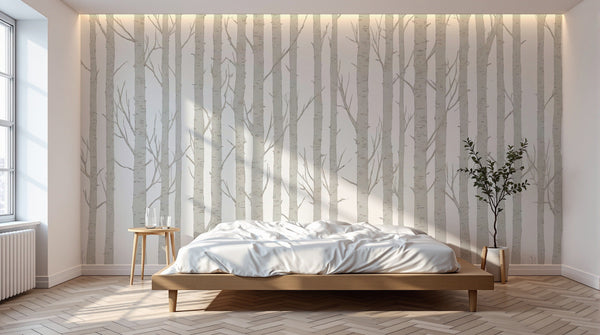
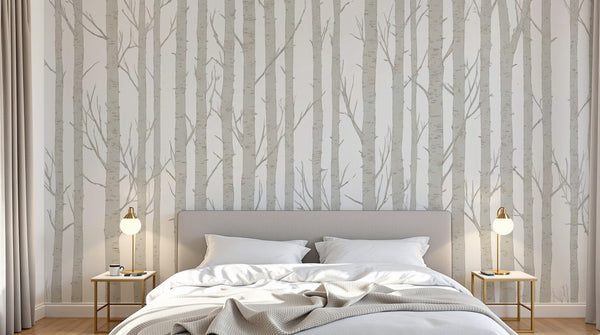
The headboard wall is the most common choice for a bedroom, and often a very good one. The eye sees it as soon as you walk in, and you also look at it from the bed every morning.
Two pitfalls to anticipate. First, bedside electrical sockets: they often land right in the middle of the pattern. Note their position before configuring your wall mural. Second, if your bed base is high (60 cm or more), the bottom of the wall mural disappears behind the mattress and bedding. Measure the height of the fully fitted bed base, subtract it from the total height of the wall, and start the mural 10 cm above the edge of the bed base. The pattern stays readable.
The wall behind the sofa: seen from behind all day
In a living room, putting the wall mural behind the sofa is tempting. It is the most visible wall in photos. In practice, you turn your back to it as soon as you sit down. You only see it when you stand up.
The wall facing the sofa, the one you look at when you watch television, is far more effective. You spend hours facing it. The pattern lives with you.
The end wall of a hallway: the one that creates perspective
A hallway has no accent wall in the classic sense: the side walls are too narrow and too close. The only relevant candidate is the end wall, the one you see on entering.
A wall mural placed there creates perspective. It visually lengthens the hallway if the pattern is vertical and airy, like birch trunks. It draws the eye and gives direction. It is a very effective placement in the whole home, for very little surface covered.
What rules a wall out: the practical criteria
Too many doors, windows or cupboards: the pattern is chopped up
Count the openings on the candidate wall. One door, two windows, a built-in cupboard: the wall mural will be cut into five pieces. The pattern can no longer be read, the panels frame empty space, and hanging becomes a headache.
The rule of thumb: if openings account for more than 40% of the wall surface, choose another wall. A solid 250 × 250 cm wall is worth more than a 400 cm wall pierced by three windows.
Direct sunlight: altered colours, disrupted reading of the pattern
A wall exposed to direct sun for several hours a day is not a good candidate, especially for patterns with warm tints or fine shades. Glare flattens the contrast. Golds, already printed in matt shades (ochre, copper, bronze, with no mirror effect), lose all their subtlety under intense frontal light.
Keep very sunny walls for deep shades or high-contrast graphic patterns. For delicate patterns, fine florals or watercolour, choose a wall in indirect light.
A wall already covered in frames: overload guaranteed
If you have a photo gallery or a collection of posters on a wall, removing it all to hang a patterned wall mural is possible. But think about what you will keep. A panoramic wall mural is already a picture in itself. Layering frames over it cancels out both.
The choice to make: either the wall mural replaces the gallery of frames, or you keep your frames on a plain wall. Never both together.
One wall mural wall: how to dress the other three
Pulling a colour from the pattern to paint the remaining walls
An accent wall works all the better when the other walls support it. The simplest method: identify the dominant background colour of your pattern, or a secondary shade present in the design, and paint the other three walls in that colour.
Worked example: with a birch wall mural with pale grey trunks on a light background, painting the remaining three walls off-white or a very light grey creates a natural continuity. The wall mural stands out without harsh contrast.
What intensity should you choose: a bold shade or a desaturated version?
If the pattern is busy (dense background, several colours), opt for a very desaturated version of the shade taken from the pattern. Almost a tinted white. The accent wall remains the strong element.
If the pattern is airy (light backgrounds, fine foliage, geometric on a cream background like the triangle wall mural), you can afford a stronger shade on the other walls. The whole stays balanced.
A simple rule: the overall saturation of the room should stay within a single register. Either everything is soft, or everything is assertive. Mixing a very colourful pattern with walls in a very different bold colour makes a tiring room.
Accent wall mural, room by room
Living room: the wall facing the sofa, not behind it
In a living room wall mural, the wall facing the sofa is almost always the right choice. You look at it for hours. It frames the television or the fireplace. It structures the room from the entrance.
Avoid the side wall the sofa backs onto, unless it is the one you see on entering. For a 4 × 5 m room, the 4 m wide wall facing the sofa is generally the ideal target. Recommended patterns: panoramic landscape, large-scale foliage, architectural. Cherry blossom with an ink branch or the beach and sea wall mural with its horizon line work well at a long viewing distance.
Bedroom: the headboard wall, with conditions
The headboard wall is the natural candidate for the bedroom. You see it on entering, and you face it on waking. Both criteria are met.
Conditions to check: no electrical socket right in the axis of the pattern, height of the fitted bed base noted before ordering. For a standard bedroom of 10 to 12 m², a headboard wall 200 to 280 cm wide in textured non-woven at 34,90 €/m² creates an architectural headboard effect without buying extra furniture.
Children’s room: the wall facing the bed, at a child’s eye level
In a child’s room, the child spends time looking at the wall facing them from their bed. That is the wall to dress, not necessarily the one behind the bed.
Also think about the height of the pattern. A 4-year-old reads a pattern between 50 cm and 150 cm from the floor. If the main drawing is placed high on the wall, they do not see it. Check the composition of the pattern before ordering, and adjust the height you order so that the strong detail falls within their line of sight.
Hallway and corridor: the end wall that catches the eye from the door
The entrance is the room where the surface-to-impact ratio is very favourable. An end wall 100 cm wide is enough: little surface, and it is the first wall your guests see.
The collection dedicated to the Hallway & Corridor offers designs made for these narrow surfaces. Favour vertical compositions: slender trunks, slender plants, architectural lines. They visually lengthen the hallway and guide the eye to the end.
Home office: the wall facing the chair, visible on video calls
For a home office, two lines of reasoning coexist. If you are often on video calls, the wall at your back becomes your permanent backdrop. A sober pattern, plant or geometric, strengthens your professional image.
If video calls are not part of your daily routine, go back to the line-of-sight rule: the wall you see while working, facing you, is the main candidate. An inspiring pattern at eye level is a worthy replacement for a white wall you stare at eight hours a day.
Dining room: the wall diners look at while eating
At the table, eyes naturally settle on the wall facing the largest number of diners. In a rectangular dining room, that is generally the wall at the end of the table or the long wall opposite the window.
A landscape or architectural panoramic wall mural creates a visual opening that makes the room feel larger without building work. Designs with perspective (city architecture, seascape) are particularly effective in rooms that lack depth.
Kitchen and bathroom: keep to dry areas
Non-woven is a matt material that is not designed for humidity, splashes or cooking vapours. In these rooms, keep the wall mural to dry areas, away from the sink, hob, shower and bath. Never as a splashback or shower wall.
Pattern scale according to viewing distance
Large room, seen from afar: large or panoramic pattern
In a living room of 25 m² or more, the accent wall is seen from 3 to 5 metres. A small repeated design will be illegible at that distance. Opt for large compositions: panoramic foliage, large-scale branches, architectural blocks of colour. The cherry blossom wall mural, with its ink branches on a light background, lends itself well to this long-distance reading.
Narrow hallway, seen up close: fine pattern or airy foliage
In a hallway 90 cm wide, you look at the end wall up close, sometimes from less than 2 metres. An overly busy pattern crushes the space. The slender trunks of a birch wall mural or a geometric pattern with a light mesh work well: they create depth without overloading the field of view.
Made to measure to the centimetre frames the pattern to the exact width
The Novomur panoramic wall mural is printed to the exact dimensions of your wall, to the centimetre. Width from 50 to 500 cm, height from 50 to 400 cm. If your headboard is 180 cm wide, the pattern is framed precisely to that width: no rough cutting, no pattern match to manage at the edges.
This precision changes everything for small areas: a 120 cm desk corner, a 90 cm alcove, a wall between two windows. The pattern is composed for the surface ordered, not cut from a roll designed for another configuration.
Enter the exact dimensions, without adding anything: 10 cm of trimming allowance is added to the width and height to secure the final cut, and included in the price calculated by the configurator.
3 pitfalls to avoid on an accent wall mural
Pitfall 1: Ordering without checking the sockets, switches and skirting boards. The pattern ends up cut in the wrong place, and nothing can be corrected after printing. Before entering your dimensions, photograph the wall and mark every obstacle. Decide whether you work around them or choose another wall.
Pitfall 2: Choosing the design on screen without ordering a sample. Colours printed on non-woven differ from monitor display. Golds in particular are printed in matt shades (ochre, copper, bronze) with no metallic reflective effect. A 30 × 20 cm sample for 3 € shows you the real result in your lighting, before you commit to the main order.
Pitfall 3: Forgetting to read the hanging guide before delivery. The panels arrive numbered, ready to hang in the order indicated. Wall preparation (clean, dry, smooth) determines the final result. The hanging guide details every step. Read it before delivery, not after.
FAQ
Which wall should you choose for a wall mural? Stand in the doorway of the room and look straight ahead. The wall your eye reaches without turning your head is the main candidate. It is the one that structures the perception of the room every time you enter.
One wall or the whole room? One wall is enough in the vast majority of cases. Covering all four walls with a panoramic pattern saturates the space and drowns the pattern. The accent effect works precisely because it contrasts with plain walls. Keep the four-wall treatment for very large rooms (over 30 m²) or very discreet patterns.
Which wall should you avoid? Avoid walls with more than two openings (doors, windows, cupboards), walls exposed to direct sun all day, and walls already covered in frames. These three configurations chop up or crush the pattern.
What colour for the other three walls? Identify the background shade or a secondary colour present in your pattern. Use that colour, in a desaturated version, to paint the other three walls. The whole stays coherent without overwhelming the accent wall.
Can you have an accent wall in a rented home? Yes, after checking what your lease says. The self-adhesive non-woven finish (39,90 €/m²) goes up without paste on a smooth, clean, dry wall and can be repositioned during hanging. Removal depends on the condition of the wall and the paint in place: first test the self-adhesive sample on a discreet corner, remove it a few days later and check the paint.
Can the pattern be framed on an area smaller than the wall? Yes. At Novomur, you enter the exact dimensions of the area to cover: a 160 cm headboard, an 80 cm alcove, a desk corner. The pattern is composed and printed for that exact area. Made to measure does not stop at the standard size of a room.
You have identified your accent wall. Measure its width and height in centimetres and enter these dimensions in the Novomur configurator: the total price is shown in the summary, before payment.
*Source: The notion of a visual focal point in the organisation of space is documented in the principles of visual perception (see Gestalt on Wikipedia).*