You’ve found the pattern. But when it comes to ordering, two doubts set in: will the colour be too dark for the room, and will the stems end up cut off sharply in the corner of the wall? This guide answers both questions, room by room, colour by colour.
Why bamboo has become the go-to pattern for Japandi
Vertical lines that lengthen and soothe
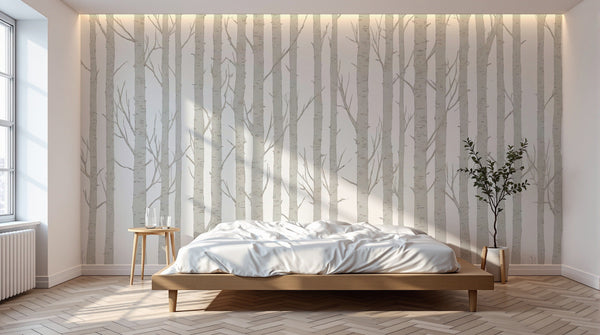
Bamboo draws repeated verticals. On a wall, these lines pull the eye upward and make the ceiling look higher than it is, useful in a studio flat or a hallway with a 2,40 m ceiling.
The effect stays subtle, not dramatic. The pattern belongs to the register of nature, not garish trompe-l’œil. That is what makes it a lasting choice: you don’t tire of it in three months.
Japandi, wabi-sabi, zen: what bamboo really says
Japandi style fuses Scandinavian aesthetics (clean lines, light wood, functionality) with Japanese aesthetics (the embraced imperfection of wabi-sabi, nature, calm). Bamboo is at the heart of this visual vocabulary.
This is not folklore. It is not a pagoda repainted brown. It is a line, a colour, a texture, in the service of an interior that breathes.
What changes with a made-to-measure wall mural
With a standard roll, the bamboo stems end up cut at the edge of the wall, in the corner, at mid-height. The pattern match is approximated. The result bothers the eye, even without knowing exactly why.
With a made-to-measure bamboo wall mural printed to the exact dimensions of your wall, you choose the crop of the pattern before you order. The panels arrive numbered, ready to hang. No pattern-match calculation: only a surplus of a few centimetres is left to trim when hanging. Width can range from 50 to 500 cm, height from 50 to 400 cm, to the centimetre.
Which colour of bamboo wall mural should you choose?
Colour is the most important decision. Here are four concrete options with their conditions of use.
Sage green bamboo: natural light and plant-like freshness
Sage green is a desaturated green, somewhere between grey and moss. It works in rooms that get at least a few hours of natural light a day.
In a north-facing room or a windowless hallway, this colour can turn cold and darken the space. In a south- or east-facing room, it creates a very pleasant plant-like freshness, summer and winter alike.
It pairs with light wood, natural linen and broad-leaved green plants. Explore the sage green wall mural collection to see the shades available.
Amber bamboo: golden warmth for rooms without direct sun
Amber is a warm beige tinted with ochre. It brings light where there isn’t much.
It is the colour to favour for a north-facing bedroom, a windowless hallway or a basement office. It makes up for the lack of sunlight without forcing it or saturating the room.
For pairings: honey-toned wood, rattan, hemp or ecru cotton fabrics. A warm, cosy result without heaviness.
Black and white bamboo: minimalist graphics, strong contrast
Black and white is the most graphic of the bamboo colourways. The stems stand out, the background recedes. The effect is bold, contemporary, almost photographic.
This choice works on a single wall (the accent wall behind the sofa or headboard), not on all four walls of a room. It needs neutral furniture (white, natural wood, light grey) to avoid visual competition.
In a small space, it can visually close the room in. Keep it for rooms over 12 m² or for hallways, where it will create a gallery effect.
Golden bamboo on a dark background: maximum impact, a fully committed accent wall
Gold bamboo on a black or anthracite background is the boldest choice. At Novomur, golds are printed in matt shades (ochre, copper, golden brown), not in metallic foil. Expect a warm, deep result with no mirror-like sheen.
This pattern works on a single wall, in a room large enough to absorb the contrast. A master bedroom, a dining room or a hallway with good ceiling height: that is where it comes into its own.
Pair it with understated materials: dark wood, matt ceramic, ecru linen. Avoid pale beige tones that fade against the dark background.
Bamboo wall mural by room: what really works
Living room and dining room: the wall behind the sofa or the table
Put the bamboo on the main wall, the one facing the entrance to the room or behind the sofa. It is the wall the eye sees first.
For a living room 3,50 m wide, a single treated wall is enough. The rest can stay in neutral paint (off-white, greige, light beige). Bamboo is the accent, not the stage backdrop.
A living room bamboo wall mural is worth choosing in a colour suited to the room’s exposure: amber if it lacks light, sage green if it is well lit, black and white for a strong effect.
Master bedroom: calm, perceived height, pairing with linen
In a bedroom, bamboo plays on verticality to visually enlarge the room and on nature to calm. A zen bedroom wall mural in sage green or amber bamboo, hung behind the headboard, is enough to transform the mood.
With a rattan headboard, washed linen sheets and a light wood parquet: the look is complete without extra effort. No need to add ‘Asian’ accessories, bamboo speaks for itself when it is well surrounded.
Home office: concentration and verticality
A bamboo home office wall mural acts differently from paint. The vertical lines frame the workspace, signal a dedicated zone and create a visual boundary between work and the rest of the home, useful when working remotely.
Prefer sage green (soothing, neutral) or black and white (stimulating, structured) depending on how you work. Amber suits if your office is not very bright.
Hallway and corridor: the depth effect on 60 to 90 cm of width
The corridor is often the hardest space to decorate. Panoramic bamboo solves several problems at once: the verticals lengthen, the pattern dresses the space without cluttering it, and the depth of the image gives an impression of space that paint alone doesn’t create.
On a width of 80 cm and a height of 250 cm, made to the centimetre is particularly useful: no waste, no pattern cut 15 cm from the ceiling.
Bathroom: what to check before hanging
A bamboo wall mural in the bathroom is possible, but with conditions. The room must be well ventilated (working extractor fan or an openable window). The wall mural must never be hung in areas of direct water splashes: neither behind the shower nor above the basin.
In a dry, airy bathroom, away from water splashes, non-woven can be suitable. If you have doubts about residual humidity, first order a 3 € sample to test the material in the real conditions of your room.
Building a coherent Japandi look around bamboo
Materials to pair: light wood, rattan, linen, washi paper
Bamboo on the wall calls for natural, lightly worked materials. Here is what works every time:
- Light wood: oak, ash, beech, untinted. Avoid very dark wood, which creates a heavy effect.
- Rattan and wicker: pendant lights, armchairs, baskets. These materials bring a texture that a wall mural doesn’t.
- Natural linen and cotton: cushions, curtains, bed linen. Neutral tones, not printed.
- Washi paper and matt ceramic: objects placed, not hung. The fewer, the better.
Together they form a coherent system with no coordination effort: each material speaks the same language as bamboo.
What is better avoided in furniture and accessories
Avoid very black or very glossy furniture against green or amber bamboo: the contrast is too harsh. Also rule out accessories with busy patterns (tropical print, colourful floral fabric) that compete directly with the bamboo.
The bamboo wall mural works with restraint, not despite it.
Renters: the self-adhesive finish, repositionable during hanging
Paste-free hanging, repositionable during hanging: how it works
The Novomur self-adhesive non-woven finish goes straight onto the wall, without paste, without water. During hanging, the paper can be repositioned: if a panel goes on crooked, you peel it off and start again.
No paste to prepare, no pasting the wall: that is what simplifies hanging this finish, on a smooth, clean and dry wall. Removal depends on the condition of the wall.
For a repositionable bamboo wall mural for rentals, the self-adhesive finish is available from 39,90 €/m².
Conditions for it to hold (and when it isn’t the right option)
Self-adhesive needs a smooth, clean and dry wall. On flaking paint, textured rendering or a slightly damp wall, adhesion will be insufficient and the edges will peel.
If your wall is not perfectly smooth, smooth non-woven at 29,90 €/m² or textured non-woven at 34,90 €/m², hung with standard paste, will be more reliable. In that case, simply plan to fill and repaint beforehand, a common and inexpensive operation.
Before ordering: 3 steps to avoid getting it wrong
1. Order the 3 € sample to check colour and material
Colours on screen vary with your monitor’s brightness and the lighting conditions in the room. A sage green bamboo that looks perfect on screen may look colder or warmer once it is in your home.
The 30 × 20 cm sample for 3 € lets you test the colour and material before you commit. It is available in all three finishes. Three euros that spare you a bad surprise on a full order.
2. Use the visualisation on a photo of your wall
On the product page, the ‘On my wall’ tab places the chosen pattern on a photo of your own wall, once you have entered your measurements. It is indicative, but it is concrete: you see the bamboo in your own home, not in a catalogue room.
It is the step that turns a doubt into a decision.
3. Enter the dimensions to the centimetre
Measure the width and height of the wall to the centimetre, not the half-metre, and enter the exact dimensions of your wall: a 10 cm trimming allowance is added automatically to the width and the height, already included in the price shown.
A 315 × 248 cm wall will be printed at 325 × 258 cm. You trim the surplus when hanging, flush with the ceiling and the floor. The pattern itself is cropped according to the part of the design you chose on the product page. See the hanging guide for the details of each step.
3 common pitfalls with a bamboo wall mural
Pitfall 1: Choosing a green that is too saturated in a dimly lit room. A vivid green in a windowless hallway crushes the space instead of airing it. Prefer sage green (desaturated, soft) or switch to amber if the room really lacks light.
Pitfall 2: Ordering standard rolls without managing the pattern match. With a roll, the bamboo stems end up cut at mid-height in the corners. The match between two panels demands a precision that most DIY hanging doesn’t allow. Panoramic made to measure solves this problem at manufacture: numbered panels that are hung edge to edge, with no pattern-match calculation.
Pitfall 3: Hanging in a bathroom without checking the humidity. No non-woven finish is waterproof. In a poorly ventilated or damp bathroom, the paper may come away. Check the extractor fan, avoid splash zones, and test with a sample before you start.
FAQ: your questions about bamboo wall murals
Does a bamboo wall mural suit a small room?
Yes, provided you choose the right colour and the right use. The vertical stems visually lengthen the room and pull the eye upward. In a small room, put the bamboo on a single wall and opt for a light colour (sage green, amber) rather than a high-contrast black and white that can close the space in.
Which bamboo colour should you choose: green, amber, black and white or gold?
Sage green for a bright room facing south or east. Amber for a north-facing room or one without windows. Black and white for an accent wall in a room over 12 m². Gold on a dark background for a strong impact in a master bedroom or dining room. In every case, order a 3 € sample before deciding.
Can you hang a bamboo wall mural in a bathroom?
Yes, under two conditions: the room must be well ventilated (extractor fan or window), and the paper must not be hung in areas of direct water splashes. In a dry, airy bathroom, away from water splashes, non-woven can be suitable. If in doubt, test first with a sample in the real conditions of your room.
What furniture goes with a bamboo wall mural?
Light wood (oak, ash), rattan, natural linen, matt ceramic. These materials share the same vocabulary as bamboo: natural, clean, lightly processed. Avoid very glossy furniture or fabrics with busy patterns that compete directly with the wall pattern.
Which finish should you choose for a bamboo wall mural in a rental?
The self-adhesive non-woven finish at 39,90 €/m²: paste-free hanging, repositionable during hanging, on a smooth, clean and dry wall. The condition is a perfectly smooth wall. On rendering or textured paint, smooth non-woven at 29,90 €/m² hung with paste will be more reliable; simply plan to fill beforehand.
Go further into the Asian world
Bamboo is not the only pattern that speaks this language. The Asian Black Ink Mountains wall mural (mist, boat, minimalist Chinese ink) creates the same atmosphere from a different angle. The Asian Blue Ink wall mural with its koi carp and lotus brings more colour within the same soothing register.
All these designs are brought together in the Asia & Orient wall mural collection. If you are looking for plant life in the broader sense, the Jungle & Nature collection completes the picture.
Configure your made-to-measure bamboo wall mural to the exact dimensions of your wall, or first order a 3 € sample to see the colour for real at home. Free tracked delivery across the EU, in 7–15 working days. Rated 5/5 on Google.